Graded Readings
Spanish Stories by Level
Choose a short reading that fits your level. Tap any unfamiliar word for an English meaning, hear it aloud, and save it for later.
Browse all levels
Spanish Reading Practice for A1 Beginners
Beginner — short sentences, familiar everyday vocabulary, and clear present-tense patterns about people, places, and routines.

El autobús verde
The green bus
A simple trip across town that practices numbers, destinations, and the present tense.

El cuarto ordenado
The Tidy Room
A child tidies a bedroom and finds a forgotten toy while practicing household vocabulary and location words.
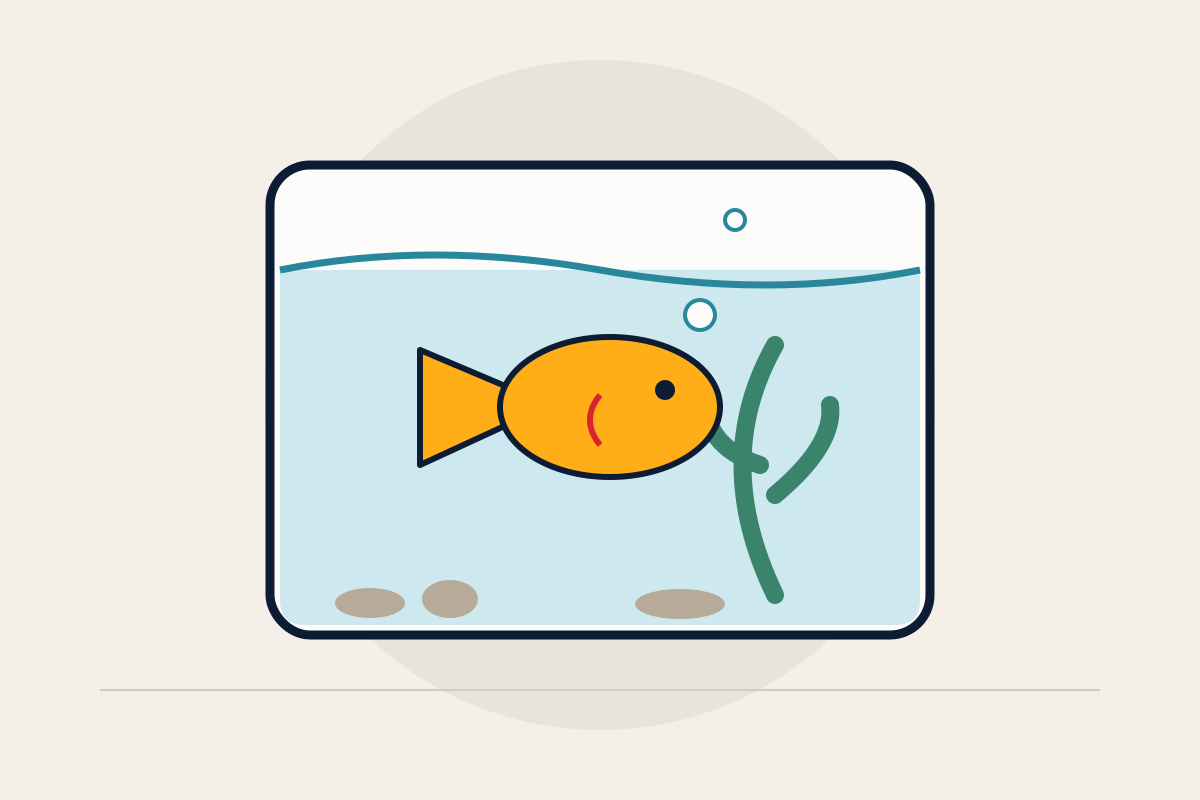
El pez de Tomás
Tomás's fish
A child feeds a pet fish, practicing basic quantities and the contrast between mucho and poco.

La camiseta amarilla
The yellow T-shirt
A simple clothes-shopping story that practices colors, sizes, and basic adjective agreement.

La clase de música
Music Class
A beginner visits a music class and talks about instruments, likes, and simple plans.

La llave perdida
The Lost Key
A short home story about finding a lost key, with location words and common present-tense verbs.
Spanish Reading Practice for A2 Elementary Learners
Elementary — accessible stories with common verbs, practical situations, and an introduction to past and future forms.
El huerto comunitario
The Community Garden
Neighbors transform an empty lot into a shared garden through past actions, routines, and future plans.

El mercado
The market
A trip to the market. Numbers, food vocabulary and basic past tense.

El paquete de Marina
Marina's parcel
A neighborly mystery that practices object pronouns and past actions in a clear sequence.

El picnic equivocado
The mixed-up picnic
A light park story that practices past actions, object pronouns, and clear sequence connectors.

El taller de cerámica
The Pottery Workshop
A first pottery class follows a small mistake and a new hobby through past-tense narration and advice.
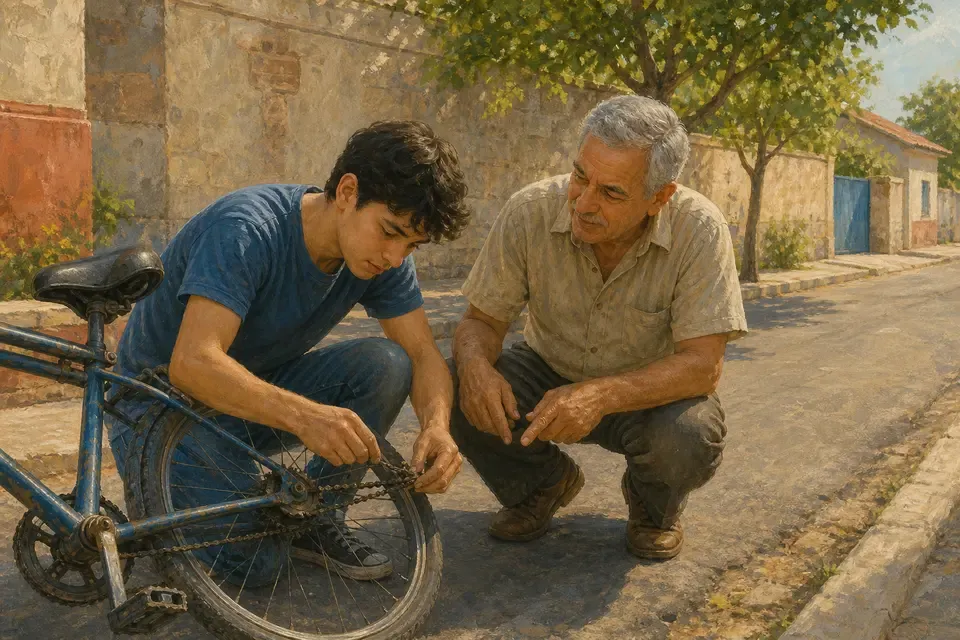
La bicicleta prestada
The borrowed bicycle
An everyday problem story that practices completed past actions and clear sequence connectors.
Spanish Reading Practice for B1 Intermediate Learners
Intermediate — everyday experiences, opinions, emotions, past tenses, and useful connectors that build longer, more natural sentences.

Vivir en una ciudad pequeña
Living in a small city
A first-person comparison of small-city life, using balanced opinion language and connectors.

El papel de un árbol
Playing a tree
A student discovers what a small theatre role requires, using past-tense contrasts to develop a story about attention and timing.
El patio de todos
Everyone's Courtyard
Neighbors redesign a shared courtyard while practicing requests and proposals with the present subjunctive.

El sendero cerrado
The closed trail
A mountain trip changes course, with contrasts between background descriptions and completed past actions.

La biblioteca de las cosas
The library of things
A skeptical neighbor discovers a lending library, with relative clauses describing people, objects, and places.

La entrevista de trabajo
The job interview
A job applicant explains a difficult decision, with conditional forms for hypothetical workplace responses.
Spanish Reading Practice for B2 Upper-Intermediate Learners
Upper intermediate — detailed narratives, abstract topics, varied tenses, idiomatic expressions, and a more natural conversational flow.

Cambio climático y responsabilidad
Climate change and responsibility
An illustrative neighborhood debate explores shared climate responsibility through concession and counterargument.

El algoritmo del comedor
The cafeteria algorithm
A school tests automated meal forecasts, with hypothetical conditionals and contrasting reported viewpoints.

El cuarto de invitados
The guest room
Two sisters navigate a temporary stay and unspoken expectations, using hypothetical conditionals to explore imagined choices and missed conversations.

El derecho a desconectar
The Right to Disconnect
An illustrative workplace story examines after-hours messages through reported viewpoints and subordinate clauses.

El reloj detenido
The stopped clock
A clock repair opens a neighborhood debate about memory, with concessive clauses weighing different perspectives.

El turismo de los mapas
Map-Based Tourism
An illustrative coastal town tests a tourist map, with hypothetical conditions and nuanced arguments about local needs.
Spanish Reading Practice for C1 Advanced Learners
Advanced — longer texts with nuanced arguments, sophisticated vocabulary, idioms, shifts in register, and complex sentence structures.

Borges y el laberinto
Borges and the labyrinth
A literary essay on Borges and the labyrinth as a structure of reading, with interpretive questions and complex subordinate clauses.

El trabajo invisible
Invisible Work
An essay on overlooked care, coordination, and maintenance, exploring how impersonal language hides responsibility.
Identidad y memoria
Identity and memory
A reflective essay on conflicting family memories and personal change, with hypothetical reasoning and nuanced contrasts.

La cortesía de discrepar
The courtesy of disagreement
An essay on productive disagreement, using concession and rhetorical contrast to distinguish understanding from agreement.

La medida de la duda
Measuring doubt
A fictional science communicator faces pressure to announce a firm result, exploring evidential language and degrees of certainty.
Spanish Reading Practice for C2 Proficient Learners
Proficient — literary and intellectually demanding language, subtle cultural references, stylistic precision, and full command of Spanish.

El arte del olvido
The art of forgetting
A reflective literary essay about keeping and letting go, using extended metaphors and careful distinctions to explore the ethics of forgetting.
El acento de los otros
Other People's Accents
A sociolinguistic essay framed by a radio presenter’s experience, using rhetorical contrasts and shifts of register to question accent prejudice.

El Ministerio de las Respuestas Pendientes
The Ministry of Pending Answers
A bureaucratic satire told by an unreliable retired official, using euphemism, ironic self-justification, and layered subordinate clauses.

La firma al pie
The signature at the bottom
An original literary story follows a ghostwriter at a book launch, using free indirect discourse and shifting voices to explore authorship and recognition.

El silencio en la música
Silence in music
An essay framed by an orchestral rehearsal, exploring musical silence through analogy, implied meaning, and shifts between observation and reflection.
A simple reading routine
How to use these Spanish readings
A graded story should help you stay inside the Spanish, not turn every sentence into a translation exercise. Use each reading in three focused passes and let context do part of the work.
- 01
Read for the main idea
Finish a first pass without stopping often. Focus on who, where, and what changed, even if a few details remain unclear.
- 02
Check useful words
Tap unfamiliar words that block the meaning or appear more than once. Hear them aloud and save only the vocabulary worth revisiting.
- 03
Read again and retell
Return to the story with fewer interruptions, then summarize it in a few Spanish sentences to turn recognition into active language.
Find the right challenge
How to choose your Spanish reading level
Start with a story whose main idea you can understand without looking up every sentence. A comfortable reading level still includes unfamiliar words, but the context should usually help you make a reasonable guess.
If you lose the plot because too much vocabulary is new, choose the level below and build momentum there. If you understand nearly everything on the first pass, move up a level for richer vocabulary and more varied grammar.
Compare the six CEFR levelsFrequently asked questions
Questions about reading in Spanish
Build a sustainable habit with texts that challenge you without interrupting the pleasure of understanding a story.
Is reading in Spanish a good way to learn the language?
Yes. Regular reading exposes you to vocabulary, grammar, sentence patterns, and natural phrasing working together in context. Unlike isolated exercises, a story gives each new word a situation and a purpose, which makes it easier to understand and remember. Reading works best as part of a balanced routine that also includes listening, speaking, and writing.
What should a Spanish beginner read?
Beginners should start with short, graded texts written with high-frequency vocabulary, clear sentence structures, and familiar topics such as family, food, routines, places, and simple plans. A1 and A2 readings are more useful than an unadapted novel at this stage because they provide meaningful practice without forcing you to stop at every sentence.
How do I know which Spanish reading level is right for me?
Choose a text that you can follow even when a few words are unfamiliar. As a practical guide, you should understand the main situation and most sentences without translating everything. If the storyline disappears because you are checking too many words, move down one level. If every sentence feels effortless and teaches you nothing new, try the next level.
Should I translate every word while reading Spanish?
No. First read for the general meaning and use the surrounding sentence to make an educated guess. Look up a word when it blocks your understanding, appears repeatedly, or feels useful for your own conversations. Leaving some nonessential words unresolved helps you develop tolerance for ambiguity, an important skill for reading and speaking with greater fluency.
How often should I read in Spanish?
A short, consistent habit is more valuable than an occasional long session. Try reading for 10 to 20 minutes several times a week, or complete one short story and revisit it before moving on. On the second reading, notice vocabulary and grammar you missed the first time. This repeated exposure builds speed, confidence, and long-term recall.
Is it better to read Spanish aloud or silently?
Both approaches train different skills. Silent reading helps you follow meaning and build speed, while reading aloud makes you pay attention to pronunciation, rhythm, and word boundaries. A useful routine is to read silently first, listen to unfamiliar words, and then reread one or two paragraphs aloud once you already understand what they mean.